
The fiscal deficit, estimated at 4.6 per cent of the gross domestic product, is expected to be around 5.6 per cent, mainly on account of factors like subdued revenue collection, poor disinvestment receipts, high global commodity prices and increasing subsidy bill.

Rural budget set to increase; likely to enhance market linkages for agri commodities

The Parliamentary Standing Committee on Commerce has observed that a massive shortfall in the budgetary allocation of over Rs 1,900 crore by the finance ministry to the industry department may have an adverse impact on the implementation of infrastructure (infra) projects in 2022-23 (FY23). While the Department for Promotion of Industry and Internal Trade (DPIIT) had sought Rs 10,267 crore from the finance ministry for FY23, it received Rs 8,348-crore allocation. For the National Industrial Corridor Development & Implementation Trust (NICDIT), the finance ministry has allocated Rs 1,500 crore instead of Rs 2,400 crore demanded for the project.

'Short term volatility is likely due to various factors, global and domestic; investors may use this as an opportunity to increase the allocation to equities.'

The increased plan allocation from the Centre is expected to help Delhi complete various projects related to next year's Commonwealth Games. The city got Rs 814 crore for projects under the Jawaharlal Nehru Urban Renewal Mission, while Rs 315.82 crore has been proposed for providing basic services to the urban poor. The total allocation also includes Rs 1,129.82 crore given to the city under urban infrastructure development for small and medium towns.

The decision to increase the MSPs (Minimum Support Prices) was taken at a meeting of the Cabinet Committee on Economic Affairs (CCEA) chaired by Prime Minister Narendra Modi. MSP is the rate at which the government buys the grain from farmers. Currently, the government fixes MSPs for 23 crops grown in both kharif and rabi seasons. Sowing of rabi (winter) crops begins from October immediately after the harvest of kharif (summer) crops.
The finance ministry may succeed in collecting over Rs 2,52,900 crore (Rs 2,529 billion) in taxes to meet the revised estimate for 2003-04 despite hefty refunds.

Sitharaman said the government will bring in a new national education policy to transform India's higher education system into one of the best in the world.

Because of the economic slowdown, the actual corporation tax collection in 2012-13 was at Rs 3,56,326 crore (Rs 3,563.26 billion), up 10.4 per cent year-on-year as against 15.6 per cent estimated in the Budget.

Finance Minister Nirmala Sitharaman will keep on the path of fiscal consolidation and opt for narrowing the FY24 fiscal deficit to as low as 5.8 per cent in the upcoming Budget, analysts said on Tuesday. The government may go for a fiscal deficit number which will be far lower than the 6.4 per cent of GDP budgeted for FY23, they said, pegging the Budget figure for the next fiscal in the range of 5.8 - 6 per cent. Given the fact that this will be the last full Budget of the present government, there may be a temptation to make it into an expansionist one.

While the likelihood of these states going the Lanka or Greece way may be an alarming assessment, the financial situation of some states such as Punjab and West Bengal is indeed quite weak.

They may be on the same side of political power, but that did not stop Railway Minister Mamata Banerjee and her predecessor Lalu Prasad from taking pot-shots at each other during the presentation of Railway Budget in the Lok Sabha.

A cut in government spending would come at the cost of growth.

All is not well with Telengana and its Chief Minister K Chandrasekhar Rao

Business success often involves a combination of planning, implementation, and continuous learning, says rediffGURU Harsh Bharwani.

Excise exemptions may be whittled in Budget to offset higher govt salaries, pensions
IThe fiscal deficit target for 2020-2021 was originally set at 3.5 per cent of GDP. But the government's revenues have collapsed and its expenditure burden will only increase over the Budget estimates.' With the government having already planned for an additional borrowing of over Rs 4 trillion, the fiscal deficit for the current year would be much higher than the Budget estimate, notes A K Bhattacharya.

Will the new Congress government implement the five 'guarantees' that helped it in part to wrest power from the Bharatiya Janata Party in toto or will they now add a "conditions apply" clause?

Government's fuel subsidy estimate was based on crude oil at $70.

The finance ministry plans to work out its borrowing calendar.

rediffGURU and financial planning expert Colonel Sanjeev Govila (retd) answers your personal finance-related questions.

The immediate revenue loss could worsen the Centre's fiscal deficit, from the budgeted 3.3 per cent of gross domestic product (GDP) to 3.7 per cent of GDP -- a massive 40-basis-point increase. It was stabilised at 3.4 per cent since 2016-17, report Abhishek Waghmare and Dilasha Seth.

It was 55.3 per cent for the same period last year, and data shows the fiscal deficit for April-May was kept in reasonable check in spite of heavy frontloading of expenditure.

The government has budgeted for total expenditure of Rs 34.83 lakh crore or 6.8 per cent of GDP. While the net tax revenue rose from Rs 5,75,697 crore in October 2020 to Rs 10,53,135 crore till October 2021, a growth of 82.93 per cent annualized, total expenditure rose only by 9.95 per cent, led by infra spending to Rs 18,26,725 crore from Rs 16,61,454 crore during the same period, the RBI said in the financial stability report.
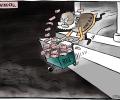
When emerging from this crisis, the govt must consider a fresh approach to reviving growth, revisiting the Centre-state fiscal balance, and devising a re-imagined GST 2.0, suggests T N Ninan.

Budget-makers in North Block are looking to maintain this fiscal status quo, in spite of tax revenues nowhere close to where the government wants and in spite of possible higher expenditure commitments.

Finance Minister Arun Jaitley presented the Union Budget.

Actor Poonam Pandey is not being considered as the brand ambassador of the government's national campaign to spread awareness on cervical cancer, Union health ministry officials said on Wednesday.

The Budget for 2018-19 has at least five takeaways that are yet to receive adequate attention, says A K Bhattacharya.

The meetings with various ministries will go on till December 12, according to an office notice

The government plans to raise resources to finance capital spending beyond the Rs 3.10 lakh crore budgeted for 2017-18 through higher borrowing or divestment receipts.

You don't prep for 2028 but for 2040, or even 2044. Sustained sporting excellence is based on mass support, grassroots development, and funding - and it is this trifecta India needs to work on, systematically, asserts Prem Panicker.

Strategic sales are tricky and were last undertaken when the Vajpayee government was in power.

'We will prioritise our requirements so that the country's maritime interests are not compromised.'

Public-sector enterprise stocks have seen a good run thus far in 2023-24 (FY24), with the S&P BSE PSU Index surging by over 26 per cent during the period, compared to an 11 per cent increase in the benchmark S&P BSE Sensex.

The government's move to freely supply coronavirus vaccines to the states for universal inoculation and extend free rations to help the poor tide over the pandemic will only add an additional 40 bps of GDP to fiscal deficit, says a report, which also called for more transparent vaccine distribution plan for efficient vaccine allocation to the states.
India is set to add 10,000 budget hotel rooms in the next two years in response to the burgeoning demand for low-cost accommodation across the country.
The states will be able to raise additional open market loans of about Rs 21,000 crore (Rs 210 billion) in the current year, according to the 2009-10 Budget estimates presented on Monday. According to Budget estimates of 2009-10, the states' share of taxes and duties is expected to increase to Rs 1,64,361 crore (Rs 1,643.61 billion) against Rs 1,60,179 crore (Rs 1,601.79 billion) in 2008-09.
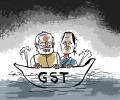
The collections stood at Rs 98,202 crore in the month, against Rs 1.02 trillion in July. The figures indicate continuation of economic slow down which was reflected in the gross domestic product (GDP) growth which plummeted to a 25-quarter low of 5 per cent in the first quarter of 2019-20, experts said.
 © 2026 Rediff.com - Advertise with us - Disclaimer - Privacy Policy - Sitemap - Feedback - About us - Terms of use - Grievances